
I looked toward the horizon that kept returning,
a portrait aging in another room.
Something disturbed the silence—
footsteps rehearsing their leaving.
This section shifts the poem away from physical memory and into emotional anticipation.
The house still exists,
the silence still lingers,
but something begins changing beneath the surface.
The poem is no longer only about remembering.
It becomes about sensing loss before it fully arrives.
There is a specific kind of grief that exists in this stage:
not the grief of complete absence,
but the grief of watching connection slowly loosen while it still technically remains.
And often,
That kind of grief feels even more unsettling.
Because nothing has ended yet—
but something already feels different.
The Horizon That Keeps Returning

I looked toward the horizon that kept returning—
Horizons are often associated with distance,
possibility,
or hope.
But here,
the horizon becomes cyclical.
Something endlessly revisited.
No matter how far the subject looks ahead,
they continue arriving at the same emotional landscape:
the same questions,
the same memories,
the same unresolved ache.
The phrase “kept returning” reflects emotional repetition.
The inability to move forward cleanly.
Sometimes grief does not move in a straight line.
Sometimes it loops.
You think you have moved past something,
only to find yourself standing in the same emotional place again.
Still wondering.
Still remembering.
Still searching for clarity that never fully arrives.
The Thought Behind the Horizon
When I wrote this image, I was thinking about emotional cycles—
how certain people continue existing within us long after relationships change.
There are individuals I no longer speak to,
yet specific versions of them remain vivid in my memory.
Not who they are now.
But who they were during a particular season of my life.
That is what the returning horizon became to me:
the inability to completely leave behind a version of someone that once felt emotionally permanent.
Sometimes memory keeps replaying people exactly as we last needed them.
Even when reality has already moved elsewhere.
A Portrait Aging in Another Room
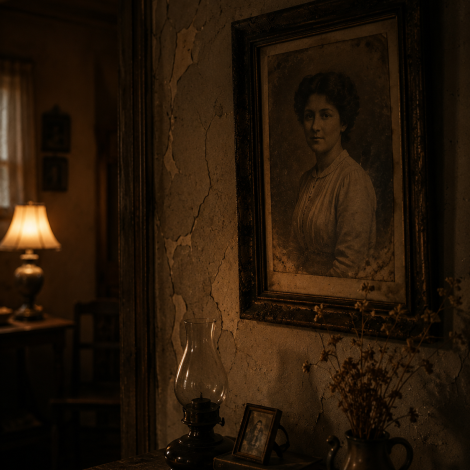
This line quietly introduces emotional distance.
The portrait symbolizes preserved memory:
something frozen in time while life continues somewhere else.
The phrase “another room” is significant here.
Because the person is no longer beside the subject—
but they are not entirely gone either.
They continue existing somewhere within the emotional architecture of memory.
A portrait does not speak.
It does not move.
It simply remains.
And sometimes,
that is exactly what old relationships become:
visible,
remembered,
emotionally preserved—
yet unreachable.
Preserved Versions of People
I think one of the strangest parts of emotional distance is realizing that memory and reality eventually stop matching.
You continue carrying an old version of someone while they continue becoming someone else elsewhere.
And often,
we grieve not only the relationship—
but the preserved version we built inside ourselves.
That is what the portrait represented while I was writing this section.
A preserved emotional image:
untouched within memory,
even while time quietly changes everything outside of it.
Footsteps Rehearsing Their Leaving

Something disturbed the silence—
footsteps rehearsing their leaving.
This is one of the quietest yet heaviest images in the poem.
Because the footsteps are not leaving yet.
They are rehearsing.
And that single word changes the emotional atmosphere entirely.
Rehearsing suggests:
- hesitation,
- preparation,
- emotional withdrawal before physical departure.
Someone is already learning how to leave before the goodbye officially happens.
There is no dramatic confrontation here.
Only subtle signs:
shortened replies,
distant attention,
lingering silences,
a warmth slowly fading without explanation.
The silence is not broken by argument.
It is broken by awareness.
The realization that absence has already begun forming quietly in the background.
The Double-Edged Nature of Leaving
I think many people understand this feeling instinctively.
The moment when conversations no longer feel the same.
When closeness begins feeling temporary.
When companionship slowly shifts into unfamiliarity.
Sometimes people leave emotionally before they leave physically.
And somehow,
the body notices it first.
That line came from the feeling of watching someone slowly become unfamiliar while still standing beside you.
Not because they changed entirely—
but because the connection itself no longer moved the same way.
I hovered my pen over the word “rehearsing” while writing this.
Because leaving is rarely immediate.
Sometimes people practice it quietly until their absence feels inevitable.
And truthfully,
I have rehearsed leaving people too.
More times than I can count.
Often as a form of self-protection.
When I sensed emotional distance forming,
I would emotionally detach first to prepare myself for the possibility of loss.
But looking back,
there were moments when that instinct became less about protection
and more about self-sabotage.
I began focusing only on the red flags.
Devaluing the connection before it had fully ended.
Trying to soften the future pain by emotionally leaving first.
And yet somehow,
I still ended up being the one left behind.
Because while I was rehearsing my leaving,
they already had one foot outside the door.
The Small World Between Two People
I gazed at the small world we built between us.
I whispered, “Where are you now?”
The room answered with a ticking clock.
The tea had long gone cold between my palms.
This section slows the poem down even further.
The phrase “small world” reflects emotional intimacy.
Relationships often create tiny universes built from:
- routines,
- private jokes,
- repeated conversations,
- familiar silences,
- shared emotional language.
And once those connections weaken,
even ordinary rooms begin feeling unfamiliar.
The question:
“Where are you now?”
is not entirely physical.
It asks:
- Where did your attention go?
- Where did your warmth disappear to?
- Where did the closeness go?
- Where did we go?
The answer never comes directly.
Instead,
the room responds only with the ticking clock.
Time becomes the only thing speaking.
And meanwhile,
the tea grows cold unnoticed.
The warmth that once existed has already begun fading quietly between them.
The Silence After the Question
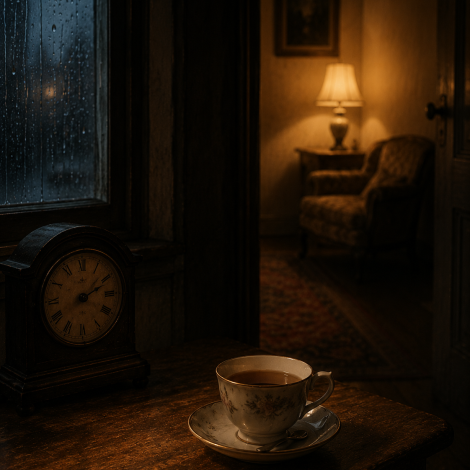
Tea appears repeatedly throughout my writing because it feels deeply personal to me.
Tea represents emotional warmth.
Companionship.
The kind of conversations shared only with people we trust deeply.
There is something intimate about sitting beside someone while holding a warm cup in your hands.
Silence feels softer there.
But cold tea carries an entirely different emotional atmosphere:
- neglect,
- delay,
- emotional distance,
- waiting too long for something to return.
I wrote this section while thinking about emotional waiting.
The kind where you continue holding onto conversations,
expectations,
or memories long after the connection itself has already cooled.
I think many of us have experienced moments where we continue asking silent questions internally,
even after realizing answers may never arrive.
And eventually,
silence itself becomes an answer.
Emotional Suspension
Part 2 exists in emotional suspension.
Nothing has fully ended yet.
But everything already feels altered.
This section captures the painful in-between:
not complete companionship,
not complete separation—
but the slow deterioration of something once steady.
Because grief rarely begins at the exact moment of departure.
Sometimes,
it begins much earlier:
- in unfamiliar silences,
- in delayed responses,
- in rehearsed footsteps,
- in tea quietly growing cold between your hands.
Wrapping It Up
Some endings do not arrive all at once.
They begin quietly—
through delayed replies,
through shifting warmth,
through footsteps already practicing how to leave.
And perhaps the hardest kind of loss
is the one the heart notices
before the goodbye is ever spoken.
Continue Reading This Series
- Part 1 – The Alcove & The Beginning of Absence
- Part 2 – Footsteps Rehearsing their Leaving
- Part 3 – Echoes of Familiar Voices
- Part 4 – Places that Only Exist Together
- Part 5 – The Weather of Memory
- Part 6 – Storms, Windows, & The Persistence of Light
- Part 7 – Which Silence Holds You Now?
- Part 8 – Returning to the Field
- Part 9 – Returning to the Quiet
The slots here are so addictive in a good way. I have had a few big wins already this week. Love jili30slotlogin
The VIP treatment here is real. I feel valued as a player and the rewards are generous. If you want a premium experience check out idrpvip4.
If you are looking for a trusted site with a huge variety of options, this is it. I have tried many others but mpoasia88 feels much more authentic.
Finally found a place that doesn’t lag during the big wins. The login process is quick and the support team is actually helpful. Give jb777login a try
The variety of options here is just insane. I love how everything loads so quickly without any lag. Give brwinxx a try if you want a reliable platform.
Solid platform with a great community feel. I’ve recommended this to a few friends and we are all having a blast. Check out 22tg88