
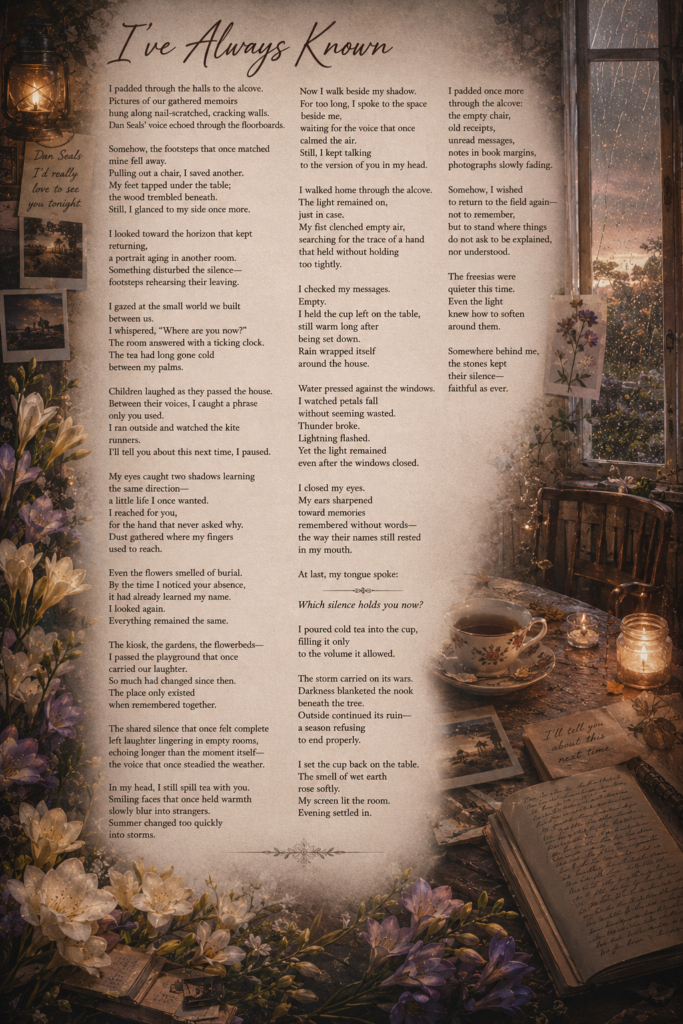
I wrote this poem one night after stumbling upon a page in the novel I was reading. The words on it sounded painfully similar to the way a friend from my past used to speak to me.
And suddenly, my mind unraveled into memory.
I remembered the first time we talked.
The last conversation we had.
The final message sitting untouched in our chat.
The silence that followed.
The version of my life that existed after her absence.
And I found myself wondering how I never learned—
when, deep down, I had always known.
I had always known that friendships could break apart.
That people could drift into distance.
That closeness was never guaranteed to last forever.
So why did I still search for friendship in everyone’s faces?
Inside the Writing Process of “I’ve Always Known”
This series explores the emotional architecture behind the poem “I’ve Always Known.” Each section examines the imagery, symbolism, emotional progression, and personal reflections that shaped the poem’s creation.
At its core, the poem is not only about loss.
It is about the quiet ways people continue existing inside memory, routine, space, and language long after they are gone.
Even after leaving, people still leave their marks behind—small, indelible traces pressed into the way we think, speak, remember, and move through the world.
And sometimes, I wonder if I left traces in her life too.
This writing process follows the gradual movement of absence:
from remembered spaces,
to emotional distance,
to lingering silence,
to acceptance without resolution.
Memory, Absence, and the Spaces People Leave Behind
Some poems begin with an idea.
Others begin with a feeling that refuses to leave.
When I wrote this poem, there was an ache beneath my ribs—a quiet heaviness shaped by memory, longing, and the strange tenderness of still wishing someone happiness even after they are no longer part of your life.
I’ve Always Known was written from the quiet aftermath of absence—the kind that does not arrive loudly, but slowly settles into familiar places.
It is a poem about memory, companionship, longing, and the persistence of people who continue existing in our lives even after they are no longer beside us.
Much like what happened in my own life, the poem moves through hallways, gardens, tables, storms, old messages, fading photographs, and empty chairs.
These spaces are not merely settings.
They become emotional landscapes—containers of memory where ordinary objects quietly carry the weight of human connection.
And sometimes, I still wonder why a scent, a phrase, a place, or even the smallest object can suddenly awaken an entire season of someone’s presence within us.
The poem explores a particular kind of grief:
not necessarily the grief of death,
but the grief of distance,
change,
and emotional disappearance.
There is no dramatic ending within the poem.
No confrontation.
No definitive closure.
Instead, the poem lingers.
It asks what happens when someone’s absence becomes so familiar that it begins living alongside you. When silence learns your routines. When memory starts speaking louder than reality.
Throughout the poem, domestic imagery repeats itself:
tea cups,
hallways,
flowerbeds,
storms against windows,
screens lighting empty rooms.
These ordinary details ground the emotional weight of the piece. They reflect how loss rarely interrupts life all at once. Instead, it quietly threads itself into daily rituals until even the smallest objects begin carrying emotional echoes.
Someone is gone—
yet traces of them remain everywhere.
The poem also mirrors the experience of speaking to memories long after conversations have ended.
The poem repeatedly reaches toward versions of the past:
the imagined voice,
the remembered laughter,
the hand once held,
the future once envisioned.
And yet, despite its sorrow, I’ve Always Known is not entirely hopeless.
There is tenderness within its silence.
The poem understands that memory itself can become a form of companionship.
Even when relationships end, fragments remain:
phrases,
habits,
shared places,
small gestures remembered years later.
By the final sections, the poem returns to the freesias and the quiet stones—symbols previously explored in The Freesias Will Know.
Here, they no longer represent longing alone, but acceptance.
A quieter understanding of memory.
A softer relationship with grief.
The stones remain silent.
Faithful as ever.
And perhaps that is what the poem ultimately tries to say:
Some absences never fully leave us.
We simply learn how to live beside the absence.
…or dare I say, without the people who once took residence in our heart.
My Creative Writing Process
Explore the opening imagery of I’ve Always Known through memory-filled spaces, gathered memoirs, nostalgia, music, and the quiet beginning of emotional absence.
A reflective poetry analysis on emotional distance, slow endings, fading companionship, and the subtle ways people begin leaving before goodbye arrives.
Discover how remembered phrases, lingering voices, childhood echoes, and emotional memory shape the atmosphere of longing in I’ve Always Known.
An exploration of shared spaces, imagined futures, emotional belonging, and how certain places only remain alive through mutual memory.
A poetic reflection on imagined conversations, lingering attachment, unread messages, and speaking to memories long after relationships have ended.
Explore rain, storms, windows, fading evenings, and enduring light as symbols of unresolved grief, emotional survival, and quiet hope.
A meditation on silence, memory, absence, language, and emotional distance in Part 7 of I’ve Always Known’s creative writing process.
The intimate reflection of I’ve Always Known, exploring quiet acceptance, remembrance, emotional healing, and learning to live beside absence.
The final part of the writing process for the poem I've Always Known.
[…] Explore the inkspirations → […]
[…] Explore my Creative Writing Process → ← Previous Post […]
[…] Explore my Creative Writing Process → ← Previous PostNext Post → Label […]
I’ve been trying a few sites lately and this one is actually smooth. The payouts are fast and the interface is very user friendly. Definitely recommend ph10jilicc to anyone looking for a reliable spot.
[1756]3555 অফিসিয়াল লগইন | সেরা অনলাইন ক্যাসিনো ও স্লট গেম,3555 এর মাধ্যমে সেরা অনলাইন স্লট গেম উপভোগ করুন। বিকাশ দিয়ে সহজ ডিপোজিট এবং অ্যাপ ডাউনলোড করে আজই আপনার যাত্রা শুরু করুন। visit: 3555
I’m really enjoying the variety of themes on ph666jili. It is a fun place to unwind after work and try my luck. The graphics are sharp and the gameplay is fluid.
I’ve been using this app for a few weeks now and the interface is super smooth. Definitely one of the best experiences I’ve had lately. Check out 8999bdapp for more details.
Just stumbled upon this site and I am already hooked. The speed is amazing and the vibes are just right for a gamer. vn47tg88
I love the JDB games available on this platform. The graphics are top notch and the winning streaks are real. Try jdbjililogin if you want a win.