
INKSPIRATION

I’ve Always Known: Returning to the Field

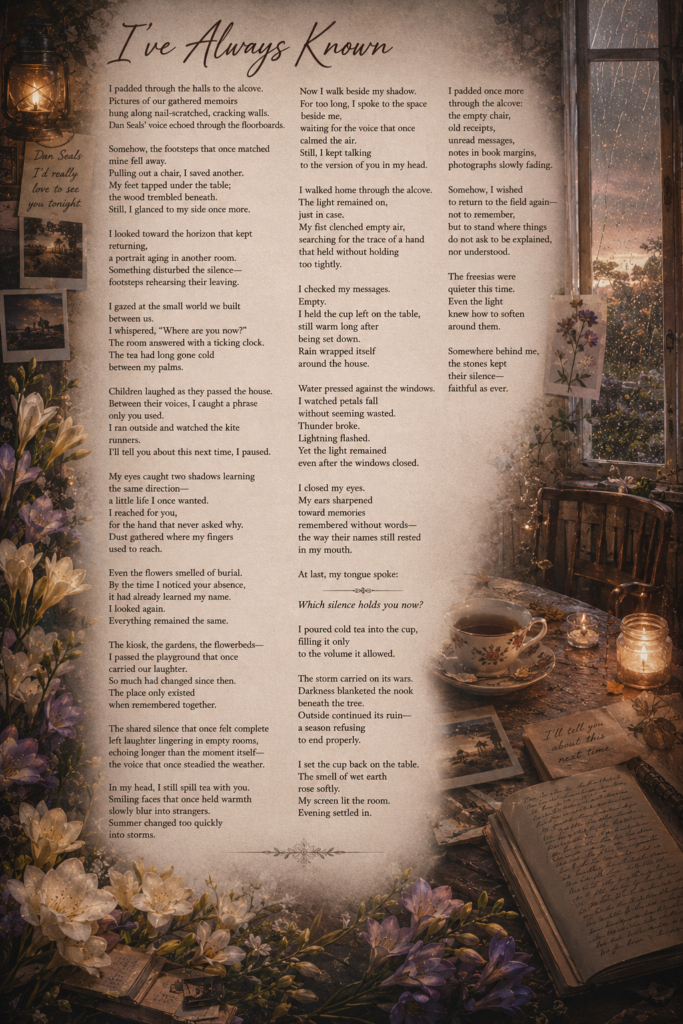
I closed my eyes.My ears sharpenedtoward memories remembered without words—the way their names still rested in my mouth. This section becomes deeply internal. The poem no longer focuses on physical spaces or visible objects. Instead, it enters quieter territory: memory carried inside the body itself. Closing the eyes symbolizes inward reflection. The subject is no […]

I’ve Always Known: Returning to the Field Read More »
I’ve Always Known: Which Silence Holds You Now?

I checked my messages.Empty.I held the cup left on the table,still warm long after being set down.Rain wrapped itself around the house. This section captures one of the quietest forms of longing: waiting for something that never arrives. The line: “I checked my messages.Empty.” is painfully modern in its simplicity. There is no dramatic confrontation.No

I’ve Always Known: Which Silence Holds You Now? Read More »

I’ve Always Known: Storms, Windows, & The Persistence of Light

Now I walk beside my shadow.For too long, I spoke to the space beside me,waiting for the voice that once calmed the air.Still, I kept talkingto the version of you in my head. This section is one of the most emotionally intimate parts of the poem. The subject is no longer simply remembering someone.They are

I’ve Always Known: Storms, Windows, & The Persistence of Light Read More »

I’ve Always Known: The Weather of Memory

The shared silence that once felt completeleft laughter lingering in empty rooms,echoing longer than the moment itself—the voice that once steadied the weather. This section explores the afterlife of companionship, friendship or relationship. Not through dramatic memories,but through echoes. The poem reflects on how certain people change the emotional atmosphere of our lives simply by

I’ve Always Known: The Weather of Memory Read More »

I’ve Always Known: Places That Only Exist Together

Even the flowers smelled of burial.By the time I noticed your absence,it had already learned my name.I looked again.Everything remained the same. This section deepens the poem’s understanding of absence. What was once emotional distance now becomes something more settled—more permanent. The subject is no longer simply anticipating loss. They are living inside it. The

I’ve Always Known: Places That Only Exist Together Read More »

I’ve Always Known: Echoes of Familiar Voices

Children laughed as they passed the house.Between their voices, I caught a phrase only you used.I ran outside and watched the kite runners.“I’ll tell you about this next time,” I paused. This section explores how memory returns unexpectedly. Not through deliberate remembrance,but through ordinary sounds. The laughter of children passing by the house becomes a

I’ve Always Known: Echoes of Familiar Voices Read More »

I’ve Always Known: Footsteps Rehearsing Their Leaving

I looked toward the horizon that kept returning,a portrait aging in another room.Something disturbed the silence—footsteps rehearsing their leaving. This section shifts the poem away from physical memory and into emotional anticipation. The house still exists,the silence still lingers,but something begins changing beneath the surface. The poem is no longer only about remembering. It becomes

I’ve Always Known: Footsteps Rehearsing Their Leaving Read More »

I’ve Always Known: The Alcove & The Beginning of Absence

I padded through the halls to the alcove.Pictures of our gathered memoirshung along nail-scratched, cracking walls.Dan Seals’ voice echoed through the floorboards. The poem opens quietly. There is no dramatic entrance.No immediate confrontation with grief. Only movement. Slow,careful,almost hesitant movement through a familiar space. The word “padded” softens the subject’s arrival into the poem. It

I’ve Always Known: The Alcove & The Beginning of Absence Read More »

The Freesias Will Know: What the Freesias Know

The freesias will knowwhat I tried to say. Some flowers bloom unseen.So do some poems. Where Meaning Finally Rests The poem does not reach outward for validation. It does not ask to be fully understood. After everything—the return to self,the search for belonging,the witnessing of emotion,the confrontation with pain,the hesitation to be seen,the questioning of

The Freesias Will Know: What the Freesias Know Read More »