
I padded through the halls to the alcove.
Pictures of our gathered memoirs
hung along nail-scratched, cracking walls.
Dan Seals’ voice echoed through the floorboards.

The poem opens quietly.
There is no dramatic entrance.
No immediate confrontation with grief.
Only movement.
Slow,
careful,
almost hesitant movement through a familiar space.
The word “padded” softens the subject’s arrival into the poem. It suggests gentleness rather than urgency—as though memory itself requires caution. The subject does not rush through the halls. They move through them carefully, carrying the emotional weight of what the space contains.
The alcove immediately becomes more than a physical location.
It transforms into a preserved emotional space:
a corner hidden away from the rest of the world,
where fragments of memory continue to exist long after moments themselves have passed.
In many ways, the alcove represents emotional preservation.
A place where the past quietly survives.
The Alcove as Emotional Memory
In my mind, I have always associated the alcove with the most delicate parts of my girlhood and childhood—the memories I treasured, the versions of myself I once carried, and even the wounds I tried to outgrow.
The space became symbolic of emotional accumulation.
Not just memories,
but evidence of becoming.
The walls are described as “nail-scratched” and “cracking,” immediately introducing the idea that time has already touched this place.
It is not pristine.
It has endured.
Growing up, I loved filling my walls with fragments of inspiration:
- caricatures,
- handwritten quotes,
- memorable dialogues from pocketbooks,
- lyrics,
- phrases I overheard and carried with me long after.
The scratched walls became symbolic of survival itself.
Holding on.
Trying to remain whole.
Trying to preserve meaning despite emotional wear.
The cracks, meanwhile, represent something quieter:
the slow weakening of certainty,
the subtle ways pain reshapes identity over time.
Sometimes deterioration does not happen all at once.
Sometimes it happens gradually:
through disappointments,
through loneliness,
through the quiet dimming of joy.
And yet despite the damage,
the photographs remain.
The memories still hang there.
Still visible.
Still present.
Still refusing to disappear.
The Music Beneath the Memory
Dan Seals’ voice echoed through the floorboards.
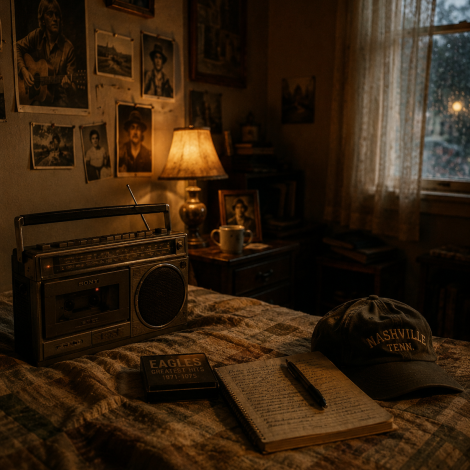
This line quietly establishes emotional atmosphere before the poem directly addresses absence.
Music often preserves memory differently than objects do.
A song can reopen entire versions of ourselves within seconds.
For me, the mention of Dan Seals was deeply intentional.
I grew up listening to “One Friend,” and perhaps because of that, I became attached to the idea of belonging—to the dream of finding friendships that felt enduring, mutual, and real.
I placed friendship on a pedestal growing up.
I longed for:
companionship that stayed,
people who reciprocated effort,
friendships built on emotional sincerity rather than convenience.
And in this verse, the home already feels inhabited by memory long before loneliness is openly admitted.
The music fills the silence before the subject fully understands what has already begun disappearing.
The Thought Behind It All
When I wrote this opening, I was thinking about how places preserve emotions longer than people do.
There are homes I no longer live in that remain vivid in my memory—not because of architecture, but because of the people who once existed within them.
Hallways,
tables,
corners of rooms,
old walls—
they become emotional landmarks once enough memory attaches itself to them.
Even now, certain songs transport me instantly back to specific moments of my life.
That is why the poem begins softly.
Because absence rarely announces itself loudly at first.
Sometimes,
it enters quietly through familiar spaces.
The Beginning of Distance
Somehow, the footsteps that once matched mine fell away.
This line quietly introduces emotional separation.
The ache here is subtle rather than explosive.
There is no argument.
No dramatic ending.
Only a shift in rhythm.
The image of footsteps once “matching” suggests companionship:
shared pace,
shared presence,
shared movement through life.
But now,
that rhythm has broken.
The word “somehow” becomes especially important because it reflects confusion rather than explanation.
There is no exact moment the relationship ended.
Only the realization that something changed gradually.
Sometimes relationships do not disappear all at once.
Sometimes they simply fall out of step.
And often,
what hurts most is how quietly it happens.
Without warning.
Without closure.
Without a single moment you can point to and say:
“This is where everything changed.”
Habit Lingering Beyond Presence
Pulling out a chair, I saved another.
My feet tapped under the table; the wood trembled beneath.
Still, I glanced to my side once more.
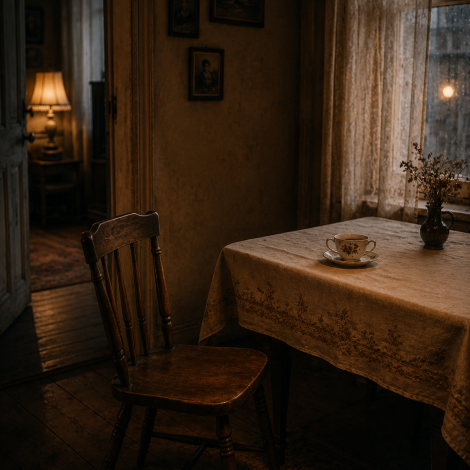
These lines reveal one of the most human aspects of grief:
habit surviving longer than presence.
When someone becomes deeply woven into your daily life, your body remembers them even before your mind catches up.
Saving them a seat.
Turning toward them instinctively.
Expecting them to still exist within familiar routines.
In this scene, pulling out another chair becomes an unconscious act of remembrance.
Not logic.
Not denial.
Muscle memory.
The trembling table subtly mirrors emotional unrest beneath outward stillness.
And despite knowing the absence,
the subject still looks to their side.
Still hoping.
Still expecting.
Hope often survives in gestures before it survives in thought.
Thoughts Behind the Lines
I think one of the loneliest realizations is understanding how routines survive after relationships end.
There are moments when you unconsciously wait for someone:
- checking your phone,
- saving them a seat,
- turning your head toward where they used to stand,
- wanting to tell them something before remembering they are no longer part of your everyday life.
I wrote this section while thinking about emotional routines—
the small habits we build around people without realizing how deeply they root themselves into us.
And when those people leave,
the routines remain behind like ghosts.
That is why the poem focuses heavily on physical gestures:
pulling out chairs,
tapping feet,
glancing sideways.
Because emotions often reveal themselves most honestly through ordinary actions.
Not through dramatic confessions.
But through instinct.
The House as Emotional Residue
In this section, the house itself behaves like memory.
The halls,
the photographs,
the music,
the table,
the chair—
all of them preserve emotional residue.
The setting is not merely decorative.
It reflects the subject’s internal state.
The alcove becomes a container for attachment:
a place where ordinary objects quietly preserve what the heart struggles to release.
And that is what makes this opening emotionally restrained yet heavy.
Nothing dramatic happens.
And yet,
everything already feels altered.
The Beginning of Emotional Absence
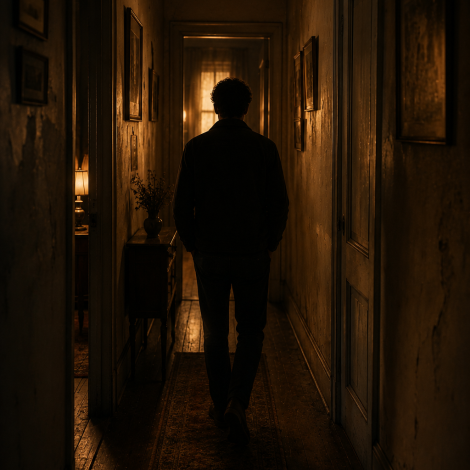
Part 1 does not portray complete loss yet.
Instead, it captures the earliest stage of emotional distance:
the moment absence first becomes noticeable within familiar spaces.
The subject is still reaching instinctively toward companionship.
Still listening.
Still looking beside them.
Still preserving space for someone else.
And perhaps that is what makes this section painful.
The realization that the body often notices absence before the heart fully accepts it.
Within the Lines
Some absences do not arrive loudly.
They begin quietly—
through unmatched footsteps,
through familiar songs,
through empty chairs waiting beside us.
And sometimes,
the hardest realization is not that someone left.
It is realizing a part of you is still waiting for them to return.
Continue Reading This Series
- Part 1 – The Alcove & The Beginning of Absence
- Part 2 – Footsteps Rehearsing their Leaving
- Part 3 – Echoes of Familiar Voices
- Part 4 – Places that Only Exist Together
- Part 5 – The Weather of Memory
- Part 6 – Storms, Windows, & The Persistence of Light
- Part 7 – Which Silence Holds You Now?
- Part 8 – Returning to the Field
- Part 9 – Returning to the Quiet
Continue Reading This Series
- Part 1 – The Alcove & The Beginning of Absence
- Part 2 – Footsteps Rehearsing their Leaving
- Part 3 – Echoes of Familiar Voices
- Part 4 – Places that Only Exist Together
- Part 5 – The Weather of Memory
- Part 6 – Storms, Windows, & The Persistence of Light
- Part 7 – Which Silence Holds You Now?
- Part 8 – Returning to the Field
- Part 9 – Returning to the Quiet
[…] Read full post Part 2: Ive Always Known: Footsteps Rehearsing Their Leaving × […]
[…] Part 1 – The Alcove & The Beginning of Absence […]
[…] Part 1 – The Alcove & The Beginning of Absence […]
[…] Part 1 – The Alcove & The Beginning of Absence […]
The login process is seamless and I never encounter any glitches. Everything just works perfectly on 24jiliparklogin.
I’ve been playing here for a few weeks now and the experience is top-notch. The games load fast and the payouts are fair. Definitely my new favorite spot! Check out pk89pkrgame
Really enjoying the variety of slots available here. I had a decent winning streak last night. Thanks idricis99.
I’ve tried a few sites lately but this one is really smooth. The games load fast and the payouts are fair. Definitely my new favorite spot! phjili588