The Invisible Gaps
I once reread a manuscript and realized halfway through that an entire subplot made no sense.
Characters made decisions that contradicted their earlier motivations, and the timeline seemed to bend in impossible ways. Events overlapped, explanations were missing, and the story suddenly felt unstable.
These gaps—often called plot holes—can quietly pull readers out of your narrative, even when they are subtle.
A reader might not always identify the exact problem, but they will feel that something is off.
This chapter is about learning to notice those invisible cracks and repairing them before they become distractions.
Identifying plot holes is less about achieving perfection and more about ensuring that your story feels coherent, logical, and satisfying for the reader.
I. Understanding What a Plot Hole Is
A plot hole is any inconsistency, contradiction, or missing explanation in a story that disrupts its internal logic.
These gaps often appear in different forms, such as:
• A character acting against their established motivation without explanation
• Events that contradict earlier information in the story
• Major consequences that appear without clear causes
• Unexplained gaps in time, place, or sequence of events
One simple method I always recommend is this:
Read a chapter slowly and jot down moments where you pause and think,
“Wait… how did this happen?”
Those moments often reveal areas where the story needs clarification.
II. Timeline and Causality Check
One of the most common sources of plot holes is inconsistent timing.
When drafting a story, scenes may shift around during revisions, and the timeline can become tangled without us noticing.
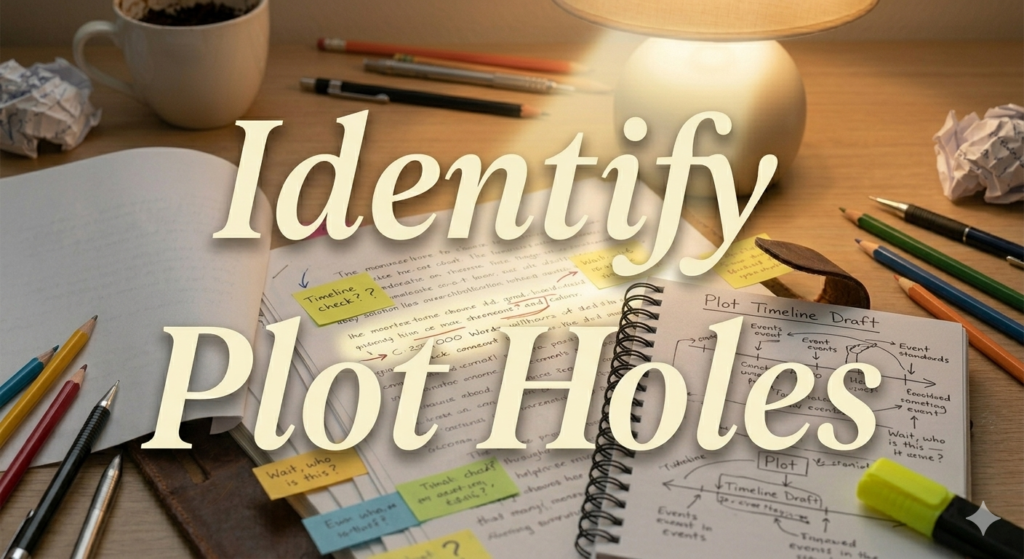
To avoid this, try mapping the sequence of your story.
• Track character movements
• Note important events and deadlines
• Ensure that cause and effect flow logically
Sometimes a simple timeline—even a rough one written in a notebook—can reveal surprising inconsistencies.
Here’s a helpful exercise:
Create a timeline for your story and mark the key events. If any moment feels impossible, unclear, or rushed, highlight it and revise accordingly.
A story flows more smoothly when its internal clock makes sense.
III. Character Consistency Audit
Characters are the emotional core of any narrative.
Plot holes often appear when characters behave in ways that contradict what we already know about them.
During revision, take time to examine each character’s journey.
Ask yourself:
• Do their choices align with their motivations?
• Does their behavior reflect their personality and growth?
• Would this character realistically make this decision?
Even minor characters should remain consistent within the story’s world.
Here’s an exercise you can try.
Choose a key scene and examine each character’s action. If their decision feels out of place, consider whether the scene needs revision—or whether their motivation simply needs clearer explanation.
Often, a small adjustment can restore the story’s internal logic.
IV. Subplots and Story Threads
Subplots enrich a narrative by adding depth, complexity, and emotional layers.
However, they also increase the possibility of inconsistencies.
When revising your manuscript, examine each subplot carefully.
• Ensure it connects meaningfully to the main story
• Remove scenes that do not support the narrative direction
• Resolve loose ends or intentionally leave them open with purpose
A helpful method is to list every subplot in your story.
For each one, ask yourself:
“Does this reveal something important about the characters or advance the main plot?”
If the answer is unclear, the subplot may need to be revised—or removed.
A focused story often becomes stronger.
V. Beta Readers as a Safety Net
Sometimes plot holes remain invisible to the author because we already know the story too well.
Fresh eyes can reveal what we overlook.
Beta readers can help identify confusing moments, missing explanations, or logical inconsistencies.
When sharing your manuscript, ask specific questions such as:
• Were there moments where the story felt confusing?
• Did any character decisions seem unrealistic?
• Were there events that didn’t fully make sense?
Receiving feedback can feel vulnerable, but it often leads to valuable insights.
Here is a simple step you can take.
Send one chapter or scene to a trusted reader and compare their observations with your timeline and character arcs. The overlap between those perspectives often reveals exactly where revisions are needed.
My Final Message
Plot holes are not failures.
They are simply signals that your story is still evolving.
By reviewing timelines, examining character choices, strengthening subplots, and inviting feedback from others, you gradually shape a manuscript that feels cohesive and satisfying.
The reader may never see the effort behind these revisions—but they will feel the difference.
Gentle Reminder
Every inconsistency you resolve strengthens your story.
A well-structured narrative allows readers to immerse themselves fully in the world you have created.
And when a story flows naturally, its logic becomes invisible—allowing emotion, tension, and meaning to take center stage.
Choose one chapter from your manuscript this week.
Map out its timeline, character motivations, and subplot connections. Highlight any gaps you discover and commit to revising them.
Small corrections often lead to the strongest improvements.
Continue the Series
If you found this helpful, continue exploring The Editing Diaries:


[…] Part 4: How to Identify Plot Holes and Strengthen Your Story […]
[…] Read Part 4: How to Identify Plot Holes and Strengthen Your Story […]
[…] Part 3: Strengthening Weak Scenes• Part 4: Identifying Plot Holes• Part 5: Working with Beta […]