
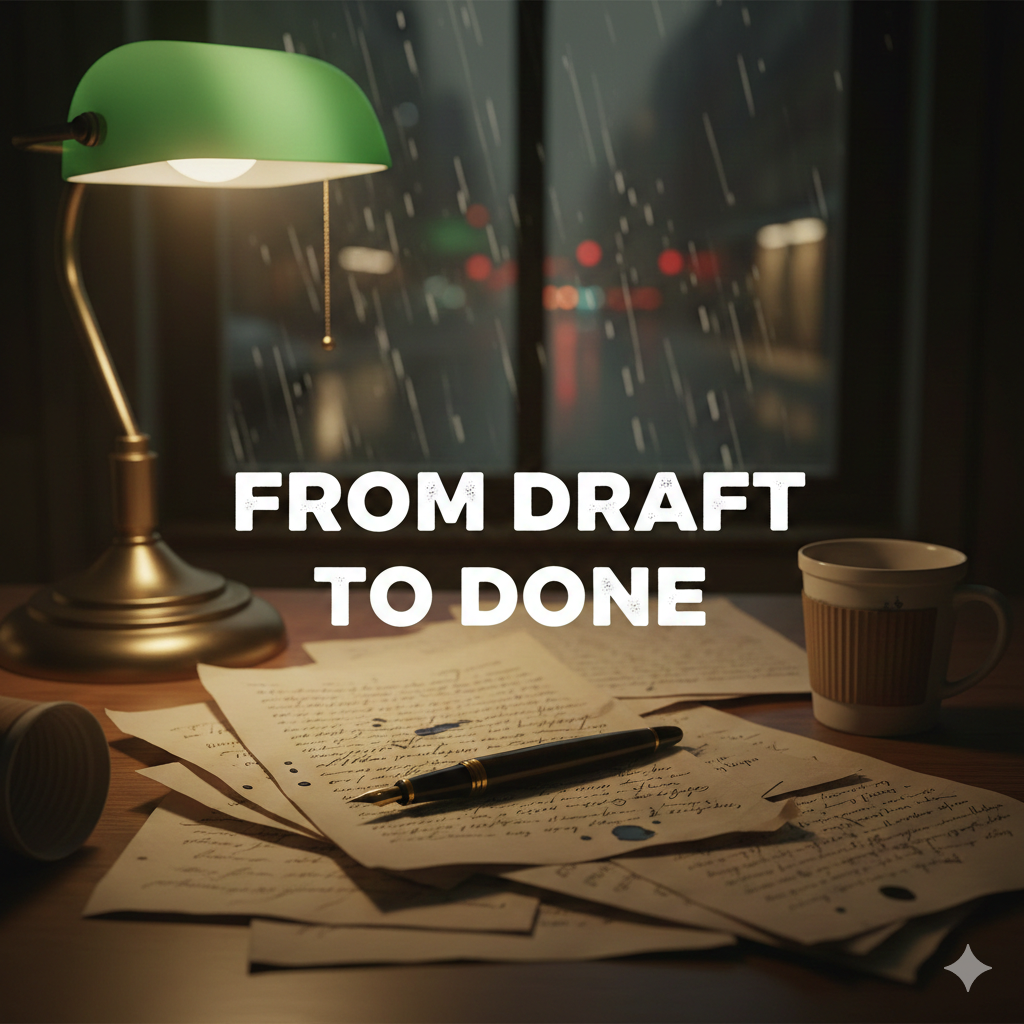
Writing a book isn’t just about starting — it’s about finishing. In From Draft to Done, we explore what it truly takes to move from the first sentence to the final period.
This series is about showing up when inspiration fades, staying when quitting feels easier, and returning to the page until your story is fully realized
What My First Manuscript Taught Me About Finishing
For the previous two series of The Writer’s Nook, we explored a beginner’s guide to writing and writing through fear.
Now let’s say you’ve finally picked up your pen.
You’ve polished it.
You’ve started scribbling.
What comes next?
There is a quiet space between starting and finishing.
When I finished my first manuscript more than a decade ago, I remember sitting at my desk, rain pelting against the flowers just outside my window. Thunder roared. The sky flashed. There was a quiet smile on my face, though my heart was thundering just as loudly.
I knew many writers never finished their drafts.
Some manuscripts stay tucked beneath beds, others gather dust in cabinets — a struggle I also explored in my Writing Through Fear series.
Some are buried beneath newer, shinier ideas.
But that night, I finished I’ll Stay.
I didn’t want to gatekeep what that took.
Most people celebrate beginnings. Announcements are made. Ideas are romanticized. Notebooks are opened with fresh hope. But the middle — the long stretch between the first sentence and the final period — is rarely talked about.
That is where this series lives.
From Draft to Done is about finishing manuscripts. Not just writing them — finishing them. It is about discipline when inspiration fades, about staying when quitting feels easier, about returning to the same pages until they begin to breathe on their own.
Because finishing is not glamorous.
But it is powerful.
And sometimes, it is the moment you finally begin to trust yourself — a lesson I also highlighted for beginners in A Beginner’s Guide for Writers.
I. The Moment I Finished My First Manuscript
Where I Was When It Happened
It was the middle of the night in February 2015 when I finished I’ll Stay. The idea was born in December 2014. I began drafting in January. A month later — just after Valentine’s Day — I wrote “The End” at the bottom corner of a white sheet of paper.
I heaved a deep breath. My heartbeat quickened.
My palm was stained with ink. My ring finger was sore from writing. Papers were stacked unevenly beside me. Outside, the storm rumbled as if marking the moment.
Before the final words dried on the page, warmth spread through me.
I was closing the story.
And for the first time, I wasn’t walking away halfway.
What Finishing Actually Felt Like
Finishing wasn’t fireworks.
It was relief.
It was quiet certainty.
It was the steady realization that I had stayed long enough to see something through.
If you want to see how to keep going when words don’t come, check out Part 2: Writing When You Don’t Feel Inspired.
II. Why I Almost Didn’t Finish My First Book
Self-Doubt and Imposter Syndrome
In the middle of drafting, I would pause and stare at my messy desk. Crumpled papers surrounded me. Doubt crowded my thoughts and suffocated the small hope budding in my chest.
I thought facing my fear would silence it.
It didn’t.
I caught myself thinking:
“This isn’t how my favorite author would write this.”
“This feels too cliché.”
I compared myself more times than I can count.
The False Starts and Abandoned Drafts
When I reached Chapter Three, I went back and rewrote Chapter One.
Then I rewrote it again.
To quiet the nagging voice inside my head, I edited far more than necessary. New ideas tempted me, and I started other projects alongside I’ll Stay. Sometimes I restarted entirely.
Perfectionism disguised itself as productivity.
But it was avoidance.
The Fear of Not Being “Good Enough”
Two questions lingered constantly:
“What if no one reads this?”
“What if it isn’t publishable?”
These thoughts hovered over me whenever I put my pen down.
This is the messy middle no one talks about.
The part where finishing feels fragile.
III. What Helped Me Finally Finish My Manuscript
Building a Simple Writing System
If you’re wondering how to finish a manuscript, this is what helped me.
I created structure.
Setting a Daily Word Count Goal
I set a daily word goal — sometimes as high as 7,000 words. I challenged myself relentlessly.
There were nights when the words flowed so smoothly I couldn’t stop. On school days, I wrote after dinner. On weekends, I wrote whenever I could.
When I wasn’t reading, my parents would find me at my desk, writing.
Consistency built momentum.
Letting the Draft Be Imperfect
I lowered my expectations.
Misspelled words? I would fix them later.
Messy cursive? I could rewrite it.
Most importantly, I stopped editing while drafting.
It was a hard habit to break — but necessary.
Finishing required forward movement, not constant correction.
IV. The Real Lesson About Finishing a Manuscript
Finishing Is About Endurance, Not Talent
Finishing is not about talent.
It wasn’t talent that helped me finish my first book.
It was endurance.
It was discipline.
It was momentum.
It was staying longer than doubt.
At the end of a manuscript, discipline shapes identity.
I Became a Writer Because I Stayed
I didn’t become a writer the day I started.
I felt like one the day I finished.
Writing is not just about putting the ink to paper. It is about showing up consistently — and carrying the story all the way to its end.
Later, I share how to balance writing with a full-time life in Part 3: Balancing a Full-Time Job and Writing.
V. What My First Manuscript Taught Me
That stormy night a decade ago became a defining chapter of my life.
The eager scribble of “The End.”
The thunder erupted after I stacked the pages together.
The dog-eared corners of the first twenty sheets.
That first manuscript represented my humble beginning.
It was proof that I could complete something I deeply cared about.
“The first manuscript teaches you how to finish.”
I almost didn’t finish. But I did.
And this is what that required.
Return to the page. Stay with the work. See it through.
Take a moment to celebrate a small milestone in your writing today — even if it’s finishing a paragraph, a page, or a chapter. Every step forward counts.
Next, we’ll explore what to do when quitting feels tempting in Part 4: What to Do When You Want to Quit.
Continue the Series
If you found this helpful, continue exploring From Draft to Done:
- Part 1: How I Finished My First Manuscript
- Part 2: Writing When You Don’t Feel Inspired
- Part 3: Balancing a Full-Time Job and Writing
- Part 4: What to Do When You Want to Quit
- Part 5: Knowing When a Story Is “Done”
- Part 6: Rewriting vs. Starting Over
- Part 7: The Art of Final Edits
Or jump to the full series overview here: From Draft to Done Series
Explore more series in the Writer’s Nook!
[…] […]
[…] improves through consistent practice. In How to Finish a Manuscript: My First Book and the Lessons I Learned, I shared the lessons my first manuscript taught me about finishing what you […]
[…] you missed it, Part 1: How I Finished My First Manuscript shows what finishing a draft really feels […]
[…] This is the same principle that helped me finish my first manuscript in Part 1: How I Finished My First Manuscript. […]