
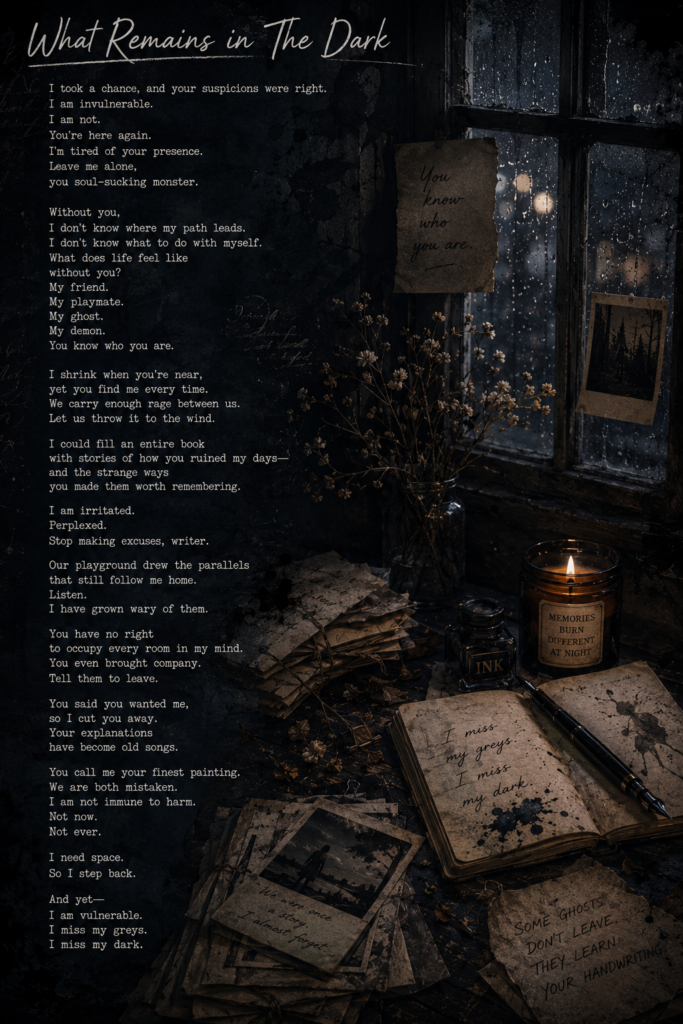
What Prompted This Poem?
Some poems arrive quietly.
Others arrive like a reckoning.
I started keeping diaries when I was a child. Looking back, I realize that writing gave me an unusual awareness of myself—both profound and incomplete.
I knew what I felt.
I could name my emotions.
I could fill pages describing my anger, sadness, longing, joy, and confusion.
Yet understanding what I felt was different from understanding what I did with those feelings. I often struggled to recognize whether my reactions were justified, healthy, or merely the product of old wounds speaking through me.
At times, I wondered if such constant self-examination made me self-absorbed.
Was it self-awareness?
Or was it simply an obsession with understanding myself?
Perhaps it was both.
The strange thing about knowing yourself too well is that you eventually learn how your mind works. When a conversation begins—whether with another person or with yourself—you already sense where it might lead.
You know which truths are waiting beneath the surface.
And sometimes, those are the truths you fear most.
What Remains in The Dark emerged from a conversation I had been avoiding for years—a conversation with the parts of myself I wanted to outgrow, silence, reject, or leave behind.
It began with a contradiction:
I am invulnerable.
I am not.
Those two lines became the foundation of the entire poem.
At first glance, the poem appears to address another person. There is anger, familiarity, resentment, longing, and a history stretching far beyond a single moment.
Yet as the poem unfolds, the boundaries between the writer and the muse begin to blur.
The monster.
The friend.
The playmate.
The ghost.
The demon.
Each becomes increasingly difficult to separate from the writer’s own inner world.
This poem explores the strange relationship we develop with our wounds.
And with ourselves.
Not all darkness arrives as an enemy.
Sometimes it grows alongside us.
Sometimes it teaches us.
Sometimes it shapes our habits, our perspectives, our art, and even our identities.
And when the time comes to release it, we discover something unsettling:
We are no longer certain who we are without it.
Throughout this Creative Writing Process series, I explore the emotional and symbolic layers behind each section of the poem—from confrontation and resistance to memory, attachment, separation, and acceptance.
Rather than offering definitive interpretations, these reflections explore the questions that surfaced while writing it.
Because for me, poetry has never been about finding answers.
It has always been about learning how to sit with the questions.
Why I Wrote What Remains in The Dark
This poem was written during a season of reflection when I found myself revisiting older versions of who I had been.
Not the idealized versions.
Not the strongest versions.
But the frightened versions.
The lonely versions.
The angry versions.
The ones I believed I had already left behind.
What surprised me was realizing they had never truly disappeared.
They were still present—in my writing, in my habits, in my memories, and in the stories I continued telling myself.
For a long time, I viewed vulnerability as something to overcome.
Something temporary.
Something that would eventually disappear if I worked hard enough.
This poem challenged that belief.
It taught me that healing is not becoming invulnerable.
Healing is learning to exist honestly with every part of yourself—even the parts that still ache.
In many ways, What Remains in The Dark feels like an overture to my larger poetry collection, The Seven Letters of Clara.
It is the quiet voice beneath the collection.
The whisper that reminds me that while I wanted to break free from my demons, there were moments when I missed them.
Moments of emotional withdrawal where I longed for the very darkness I had spent years trying to escape.
Because pain, when carried long enough, can become familiar.
And familiarity has a way of disguising itself as comfort.
In the End
What Remains in The Dark is ultimately a poem about coexistence.
Not coexistence with another person.
But coexistence with memory.
With old wounds.
With former selves.
With the darkness that once felt unbearable and the light that eventually revealed it.
The poem never fully banishes the monster.
Instead, it learns its name.
And perhaps that is enough.
[1032]laser247 Official Login | বিকাশ পেমেন্ট ও লাইভ ক্যাসিনো গাইড,laser247-এ আজই যোগ দিন। সহজ অ্যাপ ডাউনলোড এবং নিরাপদ বিকাশ পেমেন্টের মাধ্যমে অনলাইন স্লট ও লাইভ ক্যাসিনো গেমের সেরা অভিজ্ঞতা নিন। এখনই সাইন আপ করুন। visit: laser247
Bingo nights are way more exciting now that I have this installed. It is very intuitive and easy to navigate even for beginners. Love juanbingo365apk.
If you are looking for a win, this is the place to be. Everything is transparent and the games are fair. Join solusiwinlogin today.
I’ve tried a few sites lately and this one really stands out. The interface is smooth and the payouts are fast. Definitely my new favorite spot for some action. Check out 32vin
Really impressed with the variety of games available. It feels very professional and user friendly. Give jljl555 a try if you want some real fun.
If you are looking for the best slot experience, this is it. The graphics are stunning and the wins feel rewarding. Get it at pkwinlislotsgamedownload