
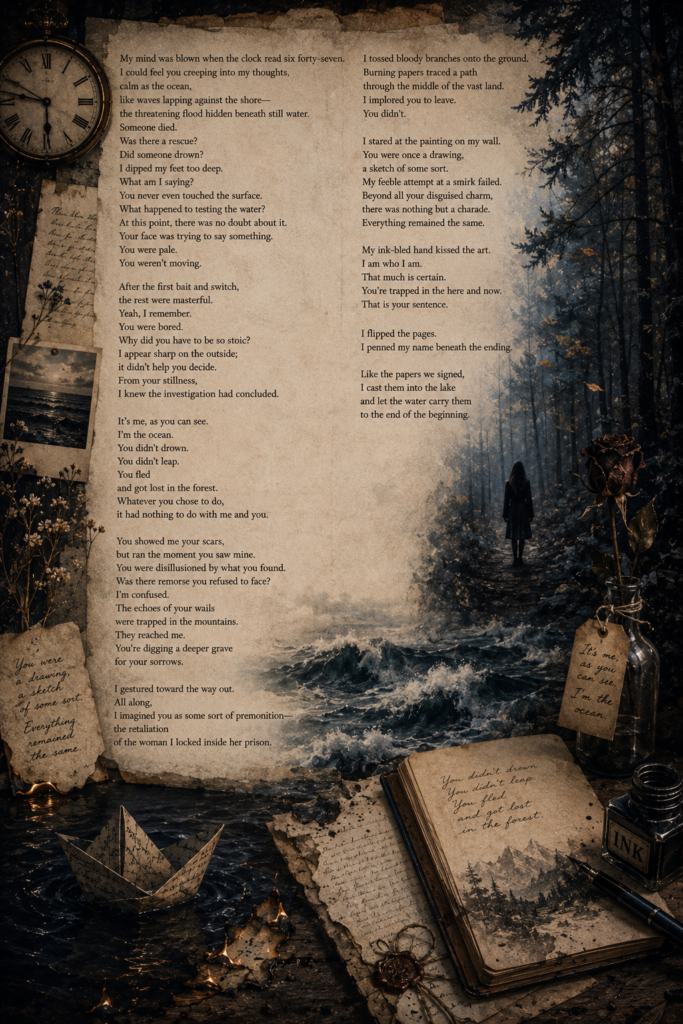
Where This Poem Began
The earliest seed of Into the Ocean was planted long before the poem itself existed.
On March 27, 2022, while brainstorming ideas for a book that had suddenly arrived in my mind late that night, I wrote a line in my notes:
“Secrets are buried just beneath the surface.”
At the time, I didn’t know where it belonged. I only knew it carried a feeling I wasn’t ready to explore.
More than a year later, in July 2023, another fragment appeared:
“Would anyone ever drive and swim into my ocean? And I remember… No one ever had the privilege to touch the surface.”
That thought eventually evolved into a verse that found its way into The Seven Letters of Clara:
“And I see my future in the opal eyes. The vision of reflecting sunlight. The rays that shine on the surface of the ocean. It’s shallow or deep but neither false nor unreal.”
The ocean kept returning.
Its imagery resurfaced again and again in my notes, my poems, and my reflections until, in the summer of 2024, while organizing the poems that would become The Seven Letters of Clara, I finally understood why.
Into the Ocean began with a realization.
The kind that arrives quietly after a conversation ends.
After the explanations stop.
After the confusion settles.
After enough distance has passed for you to finally ask:
What was I really grieving?
At first glance, this poem appears to be about another person.
Someone who arrived.
Someone who left.
Someone who carried scars of their own and disappeared before learning how to hold yours.
But beneath the surface, this poem was never entirely about them.
It was about what they revealed.
It was about projection.
It was about abandonment.
It was about the stories we build around people before we truly know them.
Most importantly, it was about the moment we realize that what we were chasing may never have been another person at all.
Sometimes, it was ourselves.
The Idea Behind the Poem
Into the Ocean emerged from a simple observation:
People often become symbols before they become people.
We meet someone and immediately begin attaching meaning to them.
We imagine possibilities.
We assign significance.
We weave narratives around their presence.
We convince ourselves they represent something larger than themselves.
A second chance.
A lesson.
A warning.
A future.
A rescue.
A punishment.
A home.
In Into the Ocean, the speaker slowly discovers that the person they are trying to understand has become a vessel for something much deeper.
The poem explores what happens when we mistake symbolism for intimacy.
When we project unfinished stories onto another person.
When we search for answers through someone who was never meant to provide them.
Why the Ocean?
The ocean became the poem’s central image because it embodies contradiction.
It appears calm.
Yet beneath its surface exists immense depth.
It can nourish.
It can destroy.
It can welcome.
It can consume.
For much of the poem, the reader is led to believe that someone else stands before the ocean.
Someone deciding whether to enter.
Someone deciding whether to stay.
Someone deciding whether to leave.
But eventually, the poem reveals something unexpected:
The speaker is not standing beside the ocean.
The speaker is the ocean.
That realization changes everything.
The poem shifts from observing another person to confronting the self.
The mystery no longer belongs to the one who left.
It belongs to the one who remained.
Projection & the Stories We Tell Ourselves
One of the poem’s central themes is projection.
Not in the clinical sense.
But in the deeply human sense.
The way we sometimes look at another person and see reflections of our own wounds.
Our fears.
Our regrets.
Our hopes.
Our unfinished chapters.
The speaker imagines the other person as a premonition.
A retaliation.
A messenger sent from a past they have not fully reconciled with.
But as the poem unfolds, that certainty begins to unravel.
Because the other person was never carrying all of that meaning.
The speaker was.
The burden belonged to them all along.
And sometimes healing begins when we stop asking what someone represented and start asking why we needed them to represent it in the first place.
The Woman in the Prison
Perhaps the most important image in the poem is not the ocean.
It is the imprisoned woman.
The speaker describes the other person as:
“the retaliation of the woman I locked inside her prison.”
That line became the emotional center of the poem.
Because Into the Ocean is ultimately about confronting versions of ourselves we have abandoned.
The younger self.
The wounded self.
The angry self.
The self hidden beneath achievement, survival, pride, and distance.
Sometimes another person accidentally leads us back to those forgotten rooms.
Not because they save us.
Not because they heal us.
But because their presence forces us to look at what we buried.
The poem asks an uncomfortable question:
What if some encounters are not meant to become love stories?
What if they exist to expose unfinished ones?
Art, Identity, & Authorship
Toward the end of the poem, the imagery shifts.
The speaker returns to sketches.
Paintings.
Ink.
Paper.
Signatures.
These images matter because they signal another transformation.
For most of the poem, the speaker searches for answers in someone else.
By the ending, they return to themselves.
The act of writing becomes symbolic.
The act of signing becomes symbolic.
The act of releasing the pages becomes symbolic.
The speaker stops investigating the person who left.
Instead, they reclaim authorship of their own story.
The ending is not reconciliation.
It is ownership.
What This Series Explores
This Creative Writing Process Series breaks Into the Ocean into seven reflections:
- Part 1 — The Tide Beneath Still Water
The first disturbance. Memory begins to surface beneath apparent calm. - Part 2 — The Body on the Shore
The investigation begins as the speaker questions what was truly lost. - Part 3 — The Investigation Concludes
Silence becomes evidence, and the search for explanations reaches its end. - Part 4 — The Ocean Speaks
The central metaphor reveals itself as the speaker reclaims their own narrative. - Part 5 — The Woman Behind the Ocean
The poem turns inward, uncovering the forgotten self hidden beneath survival. - Part 6 — The Sketch Beneath the Charade
The speaker separates the person from the portrait they had painted in memory. - Part 7 — The Here and Now
Identity, acceptance, and authorship emerge as the speaker signs their own ending.
Each section explores a different layer of the poem.
Some focus on imagery.
Others examine symbolism.
Others reflect on the personal experiences that shaped particular lines.
Together, they reveal the emotional journey hidden beneath the poem’s surface.
Finally
I don’t think Into the Ocean is a poem about losing someone.
Not entirely.
I think it is a poem about discovering what remained after they left.
The questions.
The projections.
The memories.
The versions of ourselves we thought we had outgrown.
And perhaps the most important realization of all:
Not every person enters our lives to stay.
Some arrive simply to hold up a mirror.
To reveal the depths we have spent years avoiding.
To remind us that the ocean was never them.
It was always us.
And perhaps healing begins the moment we stop searching the shoreline and finally learn how to swim.
My Creative Writing Process
Explore the creative writing process behind Into the Ocean: Part 1 – The Tide Beneath Still Water.
Explore the creative writing process behind Into the Ocean: Part 2 – The Body on the Shore.
Explore the creative writing process behind Into the Ocean: Part 3 – The Investigation Concludes.
Explore the creative writing process behind Into the Ocean: Part 4: The Ocean Speaks.
Explore the creative writing process behind Into the Ocean: Part 5: The Woman Behind the Ocean.
Explore the creative writing process behind Into the Ocean: Part 6: The Sketch Beneath the Charade.
Explore the creative writing process behind Into the Ocean: Part 7" The Here and Now.
[…] Explore the inkspirations → […]
[…] Explore my Creative Writing Process → ← Previous Post Label […]
I love how stable the connection is. No lagging even during peak hours which is rare for these kinds of sites. aajililogin is my new go-to spot for gaming.
Really impressed with the customer support here. They answered my questions in minutes. Great service and great games at phjili368.
Such a refreshing site with a ton of options. I’ve had a lucky streak here and the withdrawals were processed quickly. Definitely check out in01game.
I’ve been looking for a reliable way to access my account and this is by far the smoothest experience. Everything loads fast and the interface is super intuitive. Check out nogod888login for a hassle-free start.
Best gaming experience I have had in a long time. The bonuses are actually helpful and not just for show. Definitely try ph69jili if you want real action.
I’ve been trying a few different spots lately and this one really stands out. The interface is smooth and the payouts are quick. Definitely check out 98zcom if you want a reliable experience.